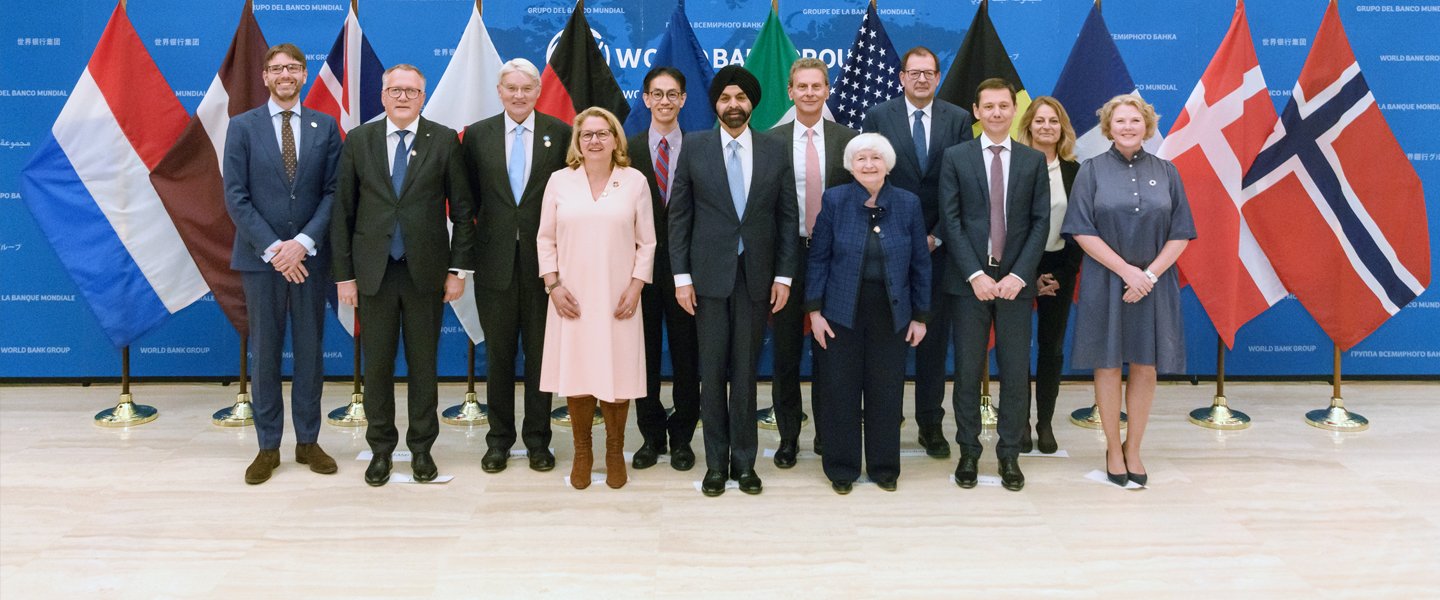
Civil society (CSO) groups in five Asian countries met with World Bank President Paul Wolfowitz and Bank's Infrastructure Vice President Kathy Sierra on May 29, 2006, while both Bank Group officials were in Tokyo for the Annual Bank Conference on Development Economics (ABCDE). Wolfowitz and Sierra spent almost two hours with the CSOs, who were linked via the Tokyo Distance Learning Center. CSO representatives in the Japanese capital, as well as those in Hanoi, Bangkok, Canberra, and Jakarta took part in the discussion, which was amiable and comprehensive. In his opening remarks, Wolfowitz noted that “civil society groups have an important role to play both in service delivery and in holding governments and donor agencies (like the Bank) accountable for results.” For that reason, he said, “we’d like to know what you think of our infrastructure initiatives…and what you think we should be doing differently or better in this area.” | Sierra outlined the five “lessons learned”, adding that she would like reaction to the report and whether the Bank had drawn the right conclusions. This, she said, “will hopefully improve our support for infrastructure development, to better target our interventions, and to manage the inevitable risks in this kind of work.” The outreach to CSOs was |  | organized as part of the Infrastructure Vice Presidency’s program to seek feedback from stakeholders on the recently released report, “Infrastructure: Lessons from 20 Years of World Bank Engagement.” That report, commissioned at the request of Wolfowitz shortly after he took office last year, outlines five key conclusions that have emerged from the Bank’s work in the sector, and how the Bank is adapting to incorporate the lessons learned. Wide Range of Questions For their part, the CSOs raised a number of issues, from whether infrastructure projects really benefit the poorest of the poor to whether the “lessons learned” have been “operationalized” at the Bank, to how to ensure that infrastructure plant, once installed, is used in a sustainable and self-sufficient manner. Wolfowitz said that the Bank probably needs “to do a more thorough, consistent, better job of measuring what we do, of evaluating results as we go, and the most important measure of results—and it may be the hardest one to get—is what difference is it actually making in the lives of the people that we’re hoping to help? It’s easier with the small-scale projects, I suspect…that may be more difficult with some of the bigger projects, but I think all the more important.” Responding to a question, Sierra said the Bank was not being doctrinaire and was not backing away from infrastructure projects that promoted sector reform: “Whether you’re in the public or the private sector, we want to see a policy environment that has cost recovery in it. We want to see accountability systems that are supported by external regulators. We would like to see more competition where it’s possible, because we know that breaking up monopolies is one way of being able to get higher quality at lower cost, though what we are saying is that there’s not one recipe for that, and we’re trying to be a bit more pragmatic.” The need for "soft" or "social" infrastructure, such as courts and information systems, was raised frequently. Wolfowitz noted while "they are clearly public sector investments that have a big pay-off, perhaps they should be thought of under the category of governance.” On the question of how to ensure that the benefits of infrastructure reach the poor, Wolfowitz explored the idea of scalability––but not in the normal sense the term is used at the Bank. “I think part of the question is whether what seems to be efficient in a context of a developed economy, whether that efficiency is degraded or even lost entirely by the inefficiencies of trying to distribute on a large scale in a less developed economy? Certainly some things like bio-mass or electric generation on a smaller scale may, in fact, be a better way to go at it because this deals with some of the distribution issues.”
Transcript of the discussion Participants in the discussion Video file (Windows) More Information: ABCDE Tokyo 2006 "Rethinking Infrastructure for Development" "Infrastructure: Lessons From the Last Two Decades of World Bank Engagement", World Bank Discussion Paper, January 2006 SHORT VERSION --- "Infrastructure: Lessons From the Last Two Decades of World Bank Engagement" World Bank and Infrastructure
|