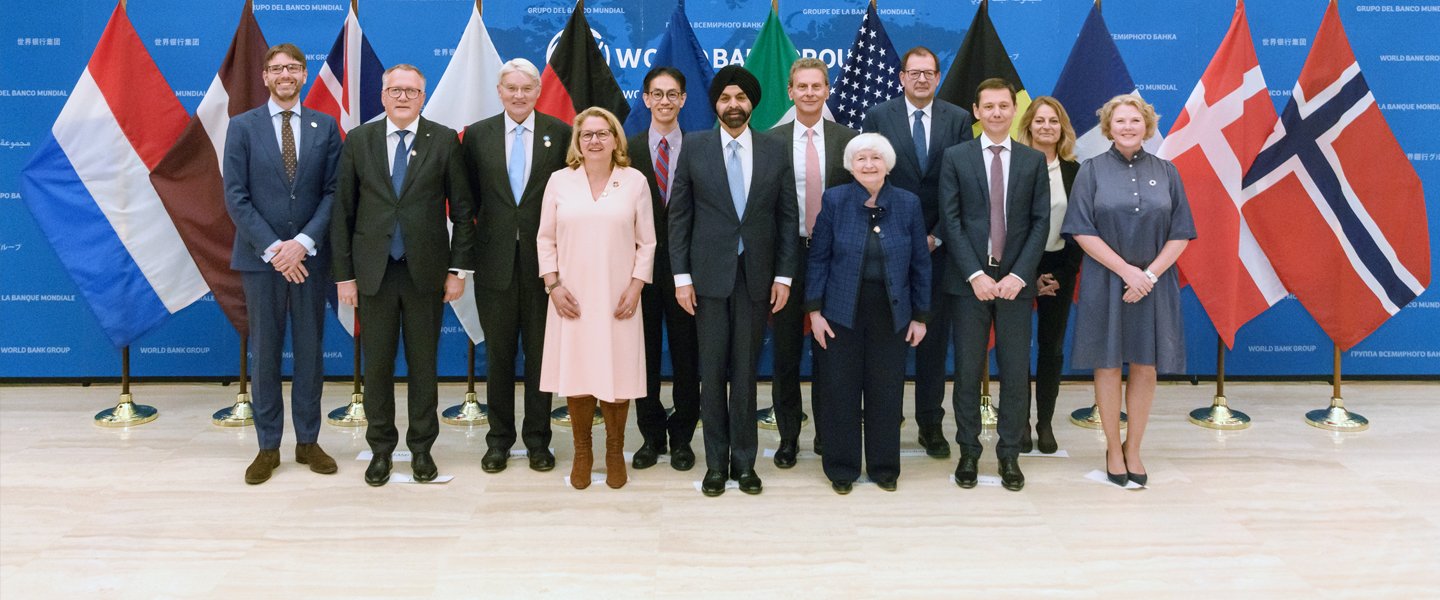
The World Bank’s Governance and Anti-Corruption (GAC) strategy, which streamlines governance work into Bank operations, received a solid boost when nearly 500 people from government, the private sector and various branches of civil society gathered in Brussels for a two-day conference. A parallel videoconference with another 500 students from 65 business schools in 35 countries provided recommendations to the conference from future leaders across the globe. The March 14-15, 2007 conference, entitled “Improving Governance and Fighting Corruption: New Frontiers in Public-Private Partnerships,” featured a keynote address by World Bank President Paul Wolfowitz, along with Liberia President Ellen Johnson Sirleaf and former Nigerian finance minister Ngozi Okonjo-Iweala. Belgian King Albert II also attended the conference along with the heads of a number of multinational corporations. The event was organized by the Belgian government and the World Bank Institute, with participation of the Organization for Economic Cooperation and Development. In addition to WBI, the Poverty Reduction and Economic Management Network, the Operational Policy and Country Services Network, and the Bank’s mining group provided speakers and made substantive inputs into the conference. The Bank’s Governance and Anti-Corruption Strategy, which since November 2006 has been the subject of a major worldwide, multi-stakeholder consultation, provided an underpinning for the conference, and the themes of the document were echoed in the conference outcomes. Belgian Foreign Minister Karel De Gucht, who hosted the conference, saw overwhelming support for the idea that governance be a central theme in building relationships among developed countries, developing countries and the private sector. The conference was the first major attempt to bring donor countries, developing countries and the private sector together for a major conference on governance. "The private sector's views and potential contributions had been somewhat neglected in the past,” De Gucht said. “This conference confirms that they have a critical role to play.” The conference was conducted in a highly interactive format and presided over by veteran BBC television anchor Nik Gowing. The aim of the conference was to provide concrete ideas that could be incorporated into the Bank’s Spring Meetings, where the GAC strategy will be discussed, and into the process of defining a multi-donor GAC strategy at the ministerial level of the 30-member OECD. At the end of the conference Belgium announced that it would join the Extractive Industries Transparency Initiative with a $650,000 contribution, making it the fourth largest donor to this mechanism aimed at improving governance in the oil, gas, and mining industries. The 24-hour, round-the globe videoconference consultation, which was run out of one of the interpreter’s booths at the conference center and was visible to participants in the main conference, used the Global Development Learning Network sites in three dozen countries. Starting at midday Brussels time on the first day and concluding at the same time the following day, the GDLN consultation was directly integrated into the main conference, with two sessions broadcast directly into the conference room. Some Conclusions from the Conference Technical support to shape institutions may be less effective than building peer and demand-side pressure. Shifts in donor support may be needed. OECD countries need to provide resources to speed the recovery of assets deposited in OECD-based banks. Stronger action is needed by OECD countries on the supply side of corruption. Development partners should make intelligent use of existing governance indicators and make concerted efforts to help countries carry out country-level governance diagnostic surveys. The private sector needs to bring more big companies into the growing group of companies that are taking a zero tolerance approach to corruption. The next generation of leaders, from grammar schools to business schools, has to be brought into the debate.
"This World Bank initiative (the GDLN consultations with business students) is completely laudable as a bottom-up policy-making initiative," said Harish Bjoor, Professor of Rural Marketing at the Indian School of Business, as quoted in the Financial Express (India, March 16, 2007.) |
Using facilitated role play and prioritization games, a list of 120 concrete recommendations emerged on which all 500 student participants voted. The five most innovative ideas were reported out to the main conference and became the subject of intense debate. In his closing remarks, Belgian Foreign Affairs Minister De Gucht picked up the student-idea of a “clean business label” as an innovative idea worth pursuing, and several participants said the student’s ideas were as good or better than those that emerged in the main conference. The conference website featured live multimedia coverage of the video consultation and the main event and generated 250,000 visits by the end of the second day of the conference. The site contains podcasts all plenary interventions and many background materials from the conference: www.improvinggovernance.be Contributed by Mark Nelson and Han Fraeters, World Bank Institute.
Press Coverage of Conference (PDF, 182 kb) |